 lukman-hakim
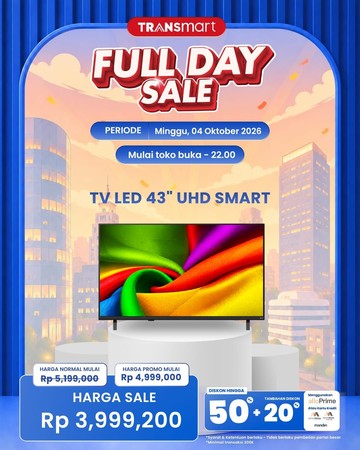
Based on data redemption campaign held on 4 Oktober 2026, one of the large electronics retailers in Indonesia offers a full-day discount scheme with a tiered discount structure of up to 50 percent plus an additional 20 percent for a wide range of products, including LED televisions. In the 43-inch screen segment, the lowest price is offered in the range of Rp 3,99 juta, with total savings stated at up to Rp 1.199.800 for selected units and subject to terms and conditions. Behind the promotional price, there is a more interesting economic story: a mid-market consumer electronics segment that continues to compete through price, while household purchasing power is still being tested against inflation and the cost of credit.
Note first what a 50+20 percent scheme actually means. Stacked discount or tiered discount is a retail technique where a base markdown is combined with a voucher, a bank promotion, or a membership benefit. In mathematical terms, a 50 percent cut followed by a 20 percent cut produces a final price of 40 percent of the original list price, or a 60 percent effective discount—not 70 percent. Many consumers, however, read the two numbers additively. This gap between the promotional claim and the arithmetic is a useful entry point to understanding how sentimen pasar (market sentiment) toward consumer goods is formed today.
Mekanika Promo dan Stok yang Menumpuk
Retailers do not run deep discounts out of pure generosity. A campaign day like this generally serves at least three functions. First, inventory clearing. TV panels are imported components with relatively high carrying cost, and stock that sits too long in a warehouse ties up working capital and storage space. Second, traffic generation. A headline price below Rp 4 juta for a 43-inch unit is not a niche figure—it sits squarely in the mid-market (segmen menengah) where most Indonesian households with a monthly disposable income in the low tens of millions of rupiah make their first or second television purchase. Third, data gathering: every voucher redemption, scan, and payment transaction becomes a record of demand elasticity.
The Rp 1.199.800 maximum savings figure also hints at the structure of the offer. Savings in that range typically come from a combination of the base markdown, a payment-method discount such as bank installment or a specific credit card, and a membership quota. This matters for analysis because the effective price depends on the consumer's access to credit lines and to specific bank channels—an asymmetry that does not necessarily make poor households better off.
Sudut Pandang Pro: Disinflation Barang dan Persaingan yang Sehat
Di satu sisi, falling sticker prices on durable goods are a genuine positive. Television, as a durable consumption item, is a classic component of household asset formation and is included in the inflation basket tracked by Badan Pusat Statistik (BPS). When a staple-adjacent durable becomes materially cheaper, the household's real purchasing power (daya beli riil)—the ability to buy more with the same nominal income—improves. A television at Rp 3,99 juta rather than Rp 5,19 juta frees up budget for groceries, education, or savings.
There is also a structural argument in favor of such competition. The presence of aggressive pricing implies supply side is expanding, distribution is widening beyond the capital city, and there is enough rivalry to prevent oligopoly pricing. Over the past several years the Indonesian consumer electronics index has generally experienced a downward trend in price even as product specifications improve, and promotional events like this are the visible tip of that longer trend.
“Di pasar barang jadi, diskon adalah cara tercepat memindahkan stok, tetapi bukan cara tercepat memperbaiki daya beli. Keduanya sering disalahartikan sebagai satu hal yang sama.” — Analis ekonomirdf到一个 institus
Sudut Pandang Kontra: Diskon sebagai Gejala, Bukan Solusi
Di sisi lain, there is a legitimate concern that heavy discounting reflects weak underlying demand rather than strong supply. When a category requires a 60 percent effective markdown to clear inventory, the alternative reading is that volumes are being sustained by promotions, not by organic growth. Retail sales index (indeks penjualan ritel) released by BPS is the metric that would distinguish the two, and a pattern of rising value but flat or falling unit volume would suggest the second interpretation.
Second, deep discounts can train consumer behavior toward wait-and-see. If buyers internalize that a price of Rp 5 juta is “unrealistic” and Rp 3,99 juta is the true market price, the reference price for the entire category shifts downward, putting pressure not only on retailers' margins but also on the ability of brands to fund marketing and after-sales service. Margin compression, in the medium term, can reduce the incentive to invest in distribution quality, warranty capability, and local assembly.
Third, credit-linked promos carry a cost. With the BI-Rate projected to remain in a restrictive-to-neutral corridor, the cost of funds for installment financing stays meaningful. A consumer who converts a television purchase into a 12-month installment has not saved Rp 1.199.800; the household has simply exchanged cash today for a liability tomorrow. Capital outflow from household savings into durable consumption is a legitimate concern when combined with high household leverage.
Makro: Inflasi, Bunga, dan Indeks Daya Beli
Based on the macro picture as of early Oktober 2026, core inflation is projected to remain contained, and the headline figure is generally expected to hover in the low-to-mid single digits year-on-year. According to Bank Indonesia data, the consumer confidence index—and here lies the key variable—tends to be a leading indicator for discretionary spending, and household purchasing power surveys from BPS typically show that the majority of respondents perceive their real income as flat. That perception, not the inflation print, is what drives a family to postpone a television replacement or, conversely, to buy during a promotion.
This is why the significance of a single promo day should be placed in context. One campaign is not a trend. But a recurring pattern of high-tensfes discount events across the year, combined with the absence of a durable improvement in the purchasing power index, would suggest that the consumer electronics market is in a structural repricing phase: demand is being held up by price, not by income.
Yang Perlu Dipantau ke Depan
Several indicators deserve attention. First, whether post-campaign unit volumes hold, or whether sales normalize downward once discounts end—visible in retail sales index data for the next two months. Second, the ratio of promotional to non-promotional pricing over a full quarter. Third, household debt service ratio and the share of installment-based purchases in retail transactions. Fourth, the direction of import values for flat panel modules; a sustained rise alongside falling retail prices would imply demand is being manufactured rather than grown.
For now, the Rp 3,99 juta offer is best read as both things at once: a real transfer of purchasing power for consumers who were already planning to buy, and a signal that the industry is competing hard for a household budget that is not expanding quickly. Recognizing both sides of that equation is the difference between shopping with a strategy and shopping with a discount.











Comments (0)