 yudi-kurniawan
Transformasi Pasca-Integrasi dan Klaim-yield yang Perlu Dibaca Ulang
Berdasarkan data pemerintah dan Releases resmiBuzz ninety—dip法律援助— Based on data the government and Bank Indonesia, efficiency gains in the logistics sector have become one of the more prominent narratives in the 2024 economy. shipping and logistics operator Pelindo, consolidate the port business, productivity of the organization is claimed to have surged by more than 70 percent compared with the pre-merger baseline. The figure, which refers to the ratio of output volume to the resources used, is a productivity jump that far exceeds the growth realized by the aggregate economy in the same period.
In itself, the claim is not extraordinary. Integration of port operators, removal of overlapping management structures, and standardization of tariffs and service procedures are theoretically capable of producing efficiency gains. The question, however, lies in the denominator: what was the baseline used, over what period, and in what unit is the productivity calculated? A 70 percent increase measured against the lowest point of 2020 will look different from a 70 percent increase against the five-year average before the merger.
Di sisi lain, a productivity figure is not the same as profitability or service quality. Gains in internal efficiency can be offset if the cost of the transition is passed on to shippers in the form of higher handling fees, or if service reliability declines. For users, what matters is not only how much output per employee rose, but also how much time a container spends waiting in the terminal.
Efisiensi Turns Around: Dari账面 Dummy ke Angka Operasional
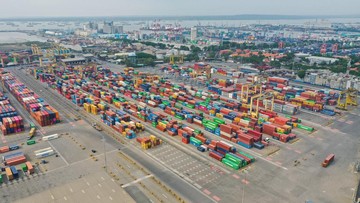
One of the more operational indicators of port efficiency is dwell time or turnaround time, namely the time gap between a vessel arriving at the anchorage and the completion of loading or unloading. In the context of a busy hub port, compressing this dwell time by even a few hours yields enormous cumulative gains. A vessel that once waited two days can complete loading in one day, and the savings can be reallocated to more frequent rotations and larger effective capacity without adding a single new crane.
Pelindo states that post-merger transformation not only increased productivity but also cut vessel and cargo turnaround time. This aligns with the direction of global port industry trends. The World Bank's Logistics Performance Index and various international consulting reviews consistently show that dwell time and customs clearance speed are the variables most strongly correlated with a country's trade competitiveness. When those variables improve, the impact is not limited to the port itself: it is felt in inventory carrying costs for exporters, in production scheduling for manufacturing, and eventually in the consumer price of goods.
Efisiensi yang/rfc benefit Inbound real in the shipping and logistics industry is not solely about cost, but also about predictability. The ability to deliver on schedule is worth more than a discount.
Di sisi lain, dwell time is also heavily influenced by factors outside the operator's control: weather conditions, congestion at sea lanes, the arrival pattern of shipping lines, and the readiness of cargo owners. Citing dwell time improvements without separating internal factors from external ones risks overstating the contribution of management.
Macro Context:为何 Absorpsi dan Utilisasi Adalah Uji Balik
Macro-wise, the gains claimed by Pelindo occur against a backdrop of a national economy whose growth has hovered around the 5 percent range, while the manufacturing and trade sectors show more modest expansion. In such conditions, the logistics sector—accounting for a portion of GDP through port services, warehousing, and freight—is often asked to become the productivity engine that supports export targets. That target is reasonable, given that logistics costs in Indonesia are still relatively high compared with several competitor countries in the ASEAN region.
On the demand side, the fundamental test lies in absorption. If efficiency gains are real and are passed on through lower service rates or faster delivery, then throughput volumes should rise in line with, or faster than, domestic and international trade growth. Capacity utilization and container volume growth become the verification variables. Conversely, if productivity rises while volume stagnates, the gains may reflect cost cutting or asset under-utilization rather than genuine efficiency improvement.
Di sisi lain, there is an important distinction between stock and flow effects. Productivity gains during a transition year can be partly statistical, because a low base and a high comparison year do not describe a sustainable trend. Analysts generally require at least two to three years of post-merger data before concluding that a structural improvement has occurred. Investors and users of the service should therefore watch not only the year-on-year percentage, but also the absolute figures: revenue per unit of throughput, operating profit, and the ratio of capital expenditure to capacity added.
Implications for the Trade Ecosystem
If the efficiency gains hold—and are followed by an improvement in schedule reliability—then the implications extend to several corners of the trade ecosystem. First, exporters of time-sensitive commodities such as textiles, footwear, or frozen goods benefit from shorter lead times. Second, the manufacturing sector can reduce safety stock inventories without raising the risk of stock-outs. Third, from a balance of payments perspective, higher service competitiveness can support the trade surplus, although the effect will be visible only gradually.
Di sisi lain, concentration of port authority in one entity brings a different set of risks. The stronger the operator's position, the greater the bargaining power it holds over service rates, and the higher the expectations on regulators to ensure that efficiency gains are shared with shippers. Oversight of tariff setting, service quality standards, and transparency in performance reporting becomes essential. A productivity figure that is not audited or not accompanied by a consistent methodology is difficult to interpret and even more difficult to use as a basis for policy.
On balance, the productivity improvement claimed after the merger deserves serious attention rather than being dismissed or celebrated outright. The direction of the change matches what integration theory predicts. The magnitude requires verification: check the baseline, compare dwell time before and after, and observe whether volume growth keeps pace. Only when all three align can the 70 percent figure be interpreted as a genuine structural efficiency gain—and not merely a recovery from a depressed base year.













Comments (0)